
4 Barriers to Financial Breakthrough and How to Overcome Them

One of the enemy’s most effective deceptions in the body of Christ has been the idea that poverty is somehow spiritual.
Somewhere along the way, believers started confusing lack with humility and financial hardship with holiness.
Poverty is not a badge of honor. It’s a consequence of refusing wisdom. And shame accompanies it. Not shame that God puts on you, but shame that naturally results from living beneath your created potential. When you were designed for dominion but you are living in lack, something is wrong. When you were called to fund the Kingdom and you live in a free society, but you can’t fund your own household, something is misaligned. That misalignment isn’t because God has abandoned you. It’s because, somewhere along the way, instruction was refused, reproof was rejected, or wisdom was ignored.
Four Types Who Miss the Blessing
Over the years, I’ve observed that there are four types of people who never seem to break through financially, no matter how many sermons they hear or books they read. These aren’t bad people. Many of them love God sincerely. But they have internal barriers that prevent them from receiving what God is trying to teach them about stewardship and prosperity.
The first type is the undecided: These are the people who agree with everything they hear but never actually commit to anything. They nod along during the sermon, highlight passages in their Bible, maybe even say Amen at the right moments. But when it’s time to make a concrete decision, they hesitate.
They’re waiting for a sign. They’re waiting for the “right time.” They’re waiting until they feel more ready. And while they wait, nothing changes. James 1:8 describes this person: “A double minded man is unstable in all his ways.”
Instability in your mind produces instability in your finances. You cannot waffle your way into wealth. At some point, you have to decide that you’re going to get this area of your life right and then act on that decision.
The second type is the unteachable: This is the person Proverbs 13:18 is directly addressing—the one who refuses instruction. They already know everything. They’ve heard this before. They don’t need another budget sermon or another stewardship class because they’ve “tried all that” and it didn’t work.
What they don’t realize is that their unwillingness to receive correction is the very thing that is blocking their breakthrough. Proverbs 12:1 says, “Whoso loveth instruction loveth knowledge: but he that hateth reproof is brutish.”
That’s strong language. God takes teachability seriously. If you want His blessing, you have to want His teaching even when it confronts areas you’d rather not examine.
The third type is the unfocused: These believers have good intentions but no follow-through. They get excited about a new financial strategy for about two weeks, then something else grabs their attention and the budget gets abandoned.
They start the debt snowball, make three payments, then forget about it when life gets busy. They set goals in January that are forgotten by March. Proverbs 24:30-34 paints a picture of this person:
I went by the field of the slothful, and by the vineyard of the man void of understanding; and, lo, it was all grown over with thorns, and nettles had covered the face thereof…. So shall thy poverty come as one that travelleth; and thy want as an armed man.
Lack of focus leads to lack of fruit. Prosperity requires sustained attention over time, not bursts of enthusiasm followed by neglect.
The fourth type is the unexpectant: This might be the saddest category of all. These are believers who have been disappointed so many times that they’ve stopped expecting anything to change. They pray about their finances, but they don’t really believe anything will happen. They hear teaching on prosperity, but in the back of their mind they’re thinking, That’s nice for other people, but it probably won’t work for me.
Hope deferred has made their heart sick (see Proverbs 13:12), and that sickness has infected their faith. But here’s what Matthew 9:29 says, “…According to your faith be it unto you.”
If you expect nothing, nothing is exactly what you’ll receive. Expectation is the atmosphere in which miracles happen. You have to believe that God’s principles will actually work for you—in your situation, with your income—starting now.
Which of these four categories describes you? Be honest. You can’t fix what you won’t face. And the good news is that all four of these barriers can be overcome. The undecided can decide today. The unteachable can humble themselves and receive instruction. The unfocused can develop discipline. The unexpectant can stir up their faith and start believing again. None of these conditions are permanent unless you choose to let them be.
Trust the Process
Now, having said all that, I need to balance it with an equally important truth: prosperity is not instant. Just because you’ve decided to get your finances right doesn’t mean you’ll be debt-free by Friday, although I’ve seen God do stranger things on many occasions. In fact, I encourage you to believe for instant miracles while at the same time walking in patience (Hebrews 6:12). Just because you’ve humbled yourself to receive instruction, it doesn’t mean a check is arriving in tomorrow’s mail. God’s Kingdom operates on process—not magic. Understanding this will save you from discouragement when the breakthrough doesn’t happen as quickly as you’d like it to.
Consider David. In 1 Samuel 16, the prophet Samuel came to Jesse’s house and anointed the youngest son, a teenager tending sheep, to be the next king of Israel. David received a genuine anointing from God. The Spirit of the Lord came upon him from that day forward. The calling was real. The promise was authentic. The destiny was set.
But David didn’t sit on the throne until he was 30 years old. That’s roughly 13 years between the anointing and the assignment. Thirteen years between the promise and the palace. Thirteen years of running from Saul, hiding in caves, leading a ragtag band of men who were in debt and discontent. Thirteen years learning to trust God in obscurity before he could lead a nation in prominence.
Why does God work this way? The reason is that anointing alone isn’t enough.
**You need character to sustain what calling initiates.
You need wisdom to steward what faith obtains.
**You need process to prepare you for the position.
If David had been crowned king at 17, he wouldn’t have been ready. The cave experiences, the wilderness seasons, and the years of warfare and waiting shaped him into the king that Israel needed.
The same is true for your financial breakthrough. God may have anointed you for prosperity, but He’s not going to skip the process that prepares you to steward it. Perhaps you are in the cave right now. You’re in the in-between season; you’ve received the promise, but you haven’t seen the fulfillment yet. Don’t despise the process. Don’t look for short-cuts. Don’t fall for get-rich-quick schemes that promise to bypass the years of faithful stewardship God is using to shape you.
The process isn’t punishment, it’s preparation. Trust it.
Excelling in the Grace of Giving
There’s one more piece we need to address before we move into practical strategies, and it might be the most important of all. Everything we’ve discussed—passing the elementary test, overcoming internal barriers, trusting the process—leads to this: you are being prepared to give.
Biblical prosperity has never been about accumulation for its own sake. And this is where many believers miss it. They want the wealth transfer, but they haven’t developed the heart of a giver. They want the abundance, but they’re still holding their current resources with a closed fist. And God, in His wisdom, will not pour new wine into old wineskins.
In 2 Corinthians 8, Paul writes to the Corinthian church about the offering being collected for the suffering believers in Jerusalem. But before he makes his appeal, he points them to an unexpected example, the churches of Macedonia:
Moreover, brethren, we do you to wit of the grace of God bestowed on the churches of Macedonia; how that in a great trial of affliction the abundance of their joy and their deep poverty abounded unto the riches of their liberality. For to their power, I bear record, yea, and beyond their power they were willing of themselves; praying us with much in treaty that we would receive the gift, and take upon them the fellowship of the ministering to the saints (2 Corinthians 8:1-4).
Look at what Paul is describing. These Macedonian believers were in “deep poverty” and “great trial of affliction.” By every natural measure, they were the last people who should have been giving. They were the ones who should have been receiving. But instead, they begged Paul for the opportunity to participate in the offering. They gave beyond their ability. They gave out of their lack. And Paul calls this “the grace of God bestowed” on them.
Generosity is a grace. It’s not just a discipline or a duty, it’s a spiritual gift, and it’s as powerful as prophecy or the working of miracles. And like every other grace, it can be grown and developed. That’s why Paul goes on to tell the Corinthians:
Therefore, as ye abound in every thing, in faith, and utterance, and knowledge, and in all diligence, and in your love to us, see that ye abound in this grace also (2 Corinthians 8:7).
The Corinthians were excelling in faith, in speech, in knowledge, in diligence, in love. They were spiritually mature in many areas. But Paul challenged them to excel in “this grace also,” the grace of giving.
In other words, generosity isn’t automatic. It’s something you learn to abound in. It’s something you grow in. It’s something you must intentionally develop.
This is why the practical strategies we’re about to discuss matter so much. Getting out of debt isn’t just about improving your credit score or reducing your stress. It’s about freeing up resources so you can excel in the grace of giving. Building wealth is about having something to give when God prompts you.
The goal of biblical prosperity is not a bigger house, it’s a bigger offering (though you will get both). It’s not a fatter retirement account, it’s a fatter harvest for the Kingdom. When you truly get this, you’ll stop looking for harvests and start looking for seeds.
You’re not just trying to escape the “middle” for your own sake. You’re positioning yourself to become a conduit of blessing that can change your family, your church, your city, and your generation. You’re preparing to participate in the wealth transfer that Scripture promises—not as a recipient only, but as a distributor of God’s resources wherever they’re needed most.
So let’s get practical. Let’s talk about the specific strategies that will move you from where you are to where God is calling you to be. It’s time to master the money so the money stops mastering you.
Master Debt or Debt Will Master You
Everything we’ve covered so far has been building to this moment. We’ve exposed the illusion of the middle class. We’ve examined the elementary test that determines your promotion. We’ve identified the internal barriers that keep people stuck. We’ve established that prosperity is a process, not a lottery. And we’ve seen that the ultimate goal is excelling in the grace of giving so that you can participate in God’s end-time wealth transfer.
I want to be very clear about something: you cannot spiritualize or meditate your way out of debt. Faith without works is dead, and that principle applies to your finances just as much as it applies to anything else. Yes, God is your Provider. Yes, He can and will do miracles. Yes, the wealth of the sinner is laid up for the just. But God has also given you wisdom, principles, and practical strategies, and He expects you to use them.
Think about it this way. If you were sick, you would pray for healing. But you would also go to the doctor, take the medicine, and follow the treatment plan. Generally speaking, unless God told you otherwise, you wouldn’t refuse medical care and say, “I’m just trusting God.” That’s not faith, that’s foolishness. The same logic applies to your financial health. Pray for provision, absolutely. Believe God for breakthrough, without question. But also make a budget. Also cut unnecessary spending. Also attack your debt with a plan.
Faith and practicality are not enemies, they’re partners.
The apostle James addressed this exact issue when he wrote:
What doth it profit, my brethren, though a man say he hath faith, and have not works? can faith save him? If a brother or sister be naked, and destitute of daily food, and one of you say unto them, Depart in peace, be ye warmed and filled; notwithstanding ye give them not those things which are needful to the body; what doth it profit? (James 2:14-16)
James is saying that faith must be accompanied by corresponding action. Believing for financial freedom while refusing to change your financial behavior is like telling a hungry person to be filled without giving them food. It sounds spiritual, but it accomplishes nothing.
Debt is not going to leave your life until you force it out. It’s not going to pack its bags and move on because you attended a prosperity conference. It’s not going to release its grip because you gave a big offering. Those things have their place, but they are not substitutes for discipline, strategy, and sustained effort over time. You have to fight for your freedom. You have to be intentional. You have to make a plan and work the plan until the plan works.
Proverbs 22:7 states it plainly: “The rich ruleth over the poor, and the borrower is servant to the lender.”
Notice the word servant. In the Hebrew, it’s the word ebed—the same word used for a slave or bondservant. When you owe money, you are in bondage to the one you owe. Your labor, your income, or your future earnings don’t fully belong to you. A portion of everything you make is already claimed by someone else.
You work, but the fruit of your work flows to Mastercard, to Sallie Mae, to the mortgage company, and to the car dealership. You’re generating wealth, but it’s building someone else’s kingdom instead of yours. This is why getting out of debt is not optional for the believer who wants to walk in their full calling. As long as you’re in bondage to lenders, you cannot fully serve God. Your resources are divided. Your options are limited. Your ability to respond to Kingdom opportunities is constrained. When God says “Give,” you have to check with your creditors first. When God says “Go,” you have to calculate whether you can afford it. Debt puts a middleman between you and obedience and
that middleman doesn’t care about your calling.
But here’s the good news, debt can be defeated. It’s not invincible. It’s not permanent. It’s not your destiny. Millions of people have climbed out of debt using proven strategies, and you can too. It will require sacrifice. It will require discipline. It will require saying “no” to what you want, so you can say “yes” to what matters more.
But, it can be done. On the other side of that process, there is a freedom you may have never experienced, the freedom to give generously, save wisely, and respond instantly when God speaks.
The strategies I’m about to share with you are not theories. These are battle-tested, practically proven methods that have helped countless people break the chains of debt and step into financial freedom. Some of them will seem simple, maybe too simple.
Don’t mistake simplicity for ineffectiveness. The basics work. The fundamentals win.
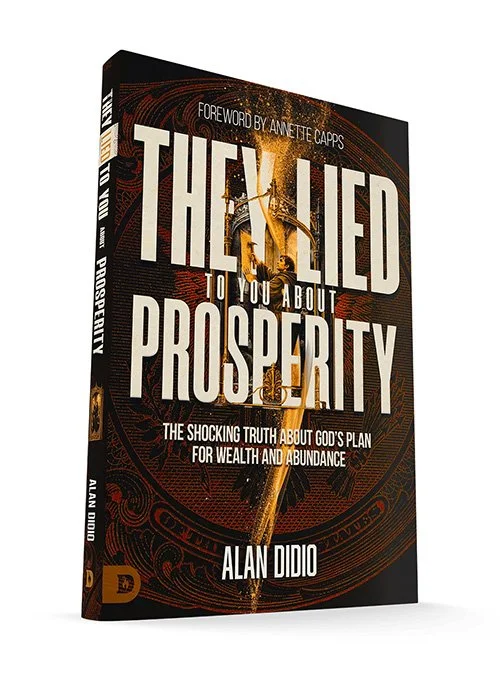
If you will commit to applying these strategies consistently over time, you will see results. So grab a pen. Take notes. Get my full book and get ready to fight for your freedom!
Break Free from Poverty Thinking and Step Into God’s Abundant Plan.
Have you been taught that wanting prosperity is unspiritual? Have you quietly felt guilty for desiring financial stability, overflow, or success? Do you wonder whether God truly delights in blessing His people—or merely tolerates it?
You're not alone. For generations, believers have been conditioned to distrust abundance, to spiritualize lack, and to apologize for blessing. But what if the real deception isn't prosperity... but the propaganda against it?
In this bold and Scripture-saturated work, a seasoned pastor with over twenty years of ministry experience confronts the lies head-on. After repenting publicly for avoiding the subject out of fear, he began a deep biblical exploration that transformed his church—and unleashed undeniable fruit. This breakthrough resource reveals what the Bible actually says about wealth, stewardship, blessing, and the spiritual war surrounding them.
As you turn these pages, you’ll discover how to:
Overcome guilt, shame, and fear surrounding money and success
Declare God's promises of provision with confidence and consistency
Steward abundance for generosity, missions, and Kingdom advancement
Walk in both prosperity and humility without compromise
Break agreement with poverty theology and renew your mind with Scripture
This is not about greed. It’s about freedom. It’s about funding the Great Commission. It's about refusing to let ideological warfare rob the Church of the resources God designed for Gospel expansion.