
Reclaim Your Authority in Christ: Why You Were Never Meant to Live Powerless
The resurrection of Jesus did not merely mark His victory over death; it established a new position for redeemed humanity.
Scripture tells us that when God raised Christ from the dead, He did more than vindicate His Son—He inaugurated a new order. Jesus was seated at the right hand of the Father, far above all principality, power, might, and dominion. Yet the astonishing claim of the New Testament is that believers are not only beneficiaries of this exaltation—they are participants in it. Paul writes that God “...raised us up together, and made us sit together in heavenly places in Christ Jesus...” (Ephesians 2:6 NKJV). This language is deliberate and unmistakable. To be seated with Christ is not only a future promise; it is a present spiritual reality. Seating speaks of rest, rule, and authority. Kings sit. Rulers sit. Those who have completed their work sit. The posture of seating indicates that victory has already been secured and that authority is now exercised from a position of completion rather than striving.
This does not mean believers are exalted independently of Christ. Rather, they are exalted in Him. Union with Christ is the central reality of salvation. Everything Jesus accomplished—His obedience, death, resurrection, ascension, and enthronement—becomes accessible to believers through union, not imitation. We do not attempt to climb into authority; we are placed into it by grace. This is why Paul repeatedly uses phrases such as in Christ, with Christ, and through Christ. Authority flows from relationship, not effort. Being seated with Christ means believers now live from a heavenly position while still operating on the earth. This is not escapism or detachment from reality; it is governmental alignment. From this seated position, believers do not fight for victory—they enforce what Christ has already accomplished. Spiritual warfare, prayer, and ministry are not desperate attempts to convince God to act; they are expressions of agreement with what heaven has already established.
This seated reality connects directly to Scripture’s declaration that believers are made kings and priests unto God. The language of kingship and priesthood is deeply rooted in God’s original design for humanity. In the beginning, Adam was created to function as both ruler and steward—governing the earth under God’s authority while maintaining communion with Him. Sin fractured this design, separating rulership from relationship. Kings ruled without holiness, and priests ministered without authority. In Christ, the two are reunited. Jesus fulfills both offices perfectly. He is the King who reigns with righteousness and the High Priest who intercedes eternally. Through union with Him, believers are restored to this dual calling. As kings, they exercise authority under Christ’s lordship. As priests, they maintain access, intimacy, and mediation through worship and prayer. Kingship without priesthood becomes tyranny; priesthood without kingship becomes powerlessness. In Christ, believers carry both kingship and priesthood—authority grounded in intimacy.
This kingship is not political domination or self-exaltation. It is delegated authority expressed through obedience. Kings under Christ rule by enforcing His will, not their own. They do not create law; they administer what has already been decreed. This is why Jesus taught His disciples to pray, “Your kingdom come. Your will be done on earth as it is in heaven” (Matthew 6:10 NKJV). Kingship is exercised through alignment, not independence. Priesthood, likewise, is not merely a ritual—it is access. Through salvation, believers are granted continual access to God’s presence. The veil that once separated humanity from God has been torn permanently. This access is not earned through discipline or maturity; it is granted through Christ’s finished work. From this place of access, believers minister unto the Lord and represent heaven to the earth.
This restored identity is made possible because believers partake of the divine nature. Scripture says that through God’s promises, believers become partakers of His divine nature, having escaped the corruption that is in the world through lust. The Greek word for partakers implies participation or sharing, not ownership. Believers do not become divine in essence, but they do share in God’s life through regeneration. At salvation, the human spirit is recreated. This is not metaphorical—it is a spiritual reality. The spirit that was once dead is made alive by the Spirit of God. This is why Jesus referred to salvation as being born from above. The believer now carries the life of God within, not merely as influence, but as an indwelling presence. The Holy Spirit does not visit; He abides. This participation in the divine nature restores access to the spirit realm. Prior to salvation, humanity is spiritually dis-connected, governed primarily by the natural senses. After salvation, the believer becomes spiritually alive and capable of perceiving, responding to, and operating from the realm of the Spirit. This does not eliminate natural reasoning; it brings it under spiritual governance. Jesus modeled this life perfectly. He lived fully in the natural world while remaining continuously aligned with the Father. He did not react to circumstances; He responded from communion. His authority flowed from intimacy. After His resurrection, He invited believers into this same pattern of life—not as gods, but as sons and daughters united to the Son.
Being seated with Christ, reigning as kings and priests, and partaking of the divine nature are not separate truths—they are one reality viewed from different angles. Seating speaks of position. Kingship speaks of authority. Priesthood speaks of access. Divine nature speaks of capacity. Together, they describe the restored life of the believer in Christ. Yet all of this must remain anchored in humility. Authority does not exist to elevate the believer; it exists to reveal Jesus. Kingship is exercised in service. Priesthood is expressed in surrender. Participation in the divine nature produces holiness, not arrogance. The closer believers walk in authority, the more clearly Christ should be seen.
The ultimate goal of this restored position is not power for its own sake, but representation. Believers are seated so they can reign, reign so they can serve, and serve so Christ can be revealed. Heaven’s authority is released on earth through those who know who they are in Him. Jesus reigns now, seated at the right hand of the Father, and astonishingly, those who are in Him reign with Him—not as rivals, but as redeemed sons and daughters carrying His authority, reflecting His nature, and advancing His Kingdom until the day He is revealed in fullness. Because we are seated with Christ, share in His authority, and partake of His divine nature, the implications are unavoidable. If our position in Him is real and present, then the life that flows from that position must also be real and present. If Jesus truly passed authority to the Church, then it becomes impossible to argue that the supernatural is no longer for today. You cannot separate authority from function, nor can you separate the Holy Spirit from manifestation. To do so is to misunderstand both the nature of the Spirit and the intent of Christ’s commission. Jesus did not declare that all authority belonged to Him simply to make a theological point; He declared it so that He could delegate it. The Great Commission is not a suggestion; it is an authorized sending. Christ’s authority did not terminate in heaven—it was released through His body on the earth. If that authority is still intact, as Scripture makes clear, then the expression of that authority must also still be intact. Otherwise, authority becomes theoretical rather than functional, and the commission becomes symbolic rather than actionable.
The supernatural is not an optional feature of Christianity; it is the natural outworking of a supernatural Kingdom. Jesus did not instruct His disciples to talk about the Kingdom merely—He instructed them to demonstrate it. He did not say the Kingdom was coming someday; He said it was at hand. The evidence of that Kingdom was not found in words alone, but in power. If the authority Jesus carried was necessary to demonstrate the Kingdom, then why would that same authority be unnecessary now? The idea that the supernatural ceased is not rooted in Scripture; it is rooted in experience—or rather, the lack of it. When expectation diminishes, theology often adjusts to protect disappointment. But Scripture never teaches that the authority of Christ would outlast the expression of His power. In fact, the opposite is true. Jesus said that the works He did would continue and even increase in reach because He was going to the Father. His ascension did not mark the end of power; it marked its multiplication.
This brings us to a question that must be asked honestly: how can the Holy Spirit live in a believer and that believer be no different from someone who does not have the Spirit? If the same Spirit who raised Jesus from the dead now dwells in us, then something must be different—not hypothetically, but tangibly. The indwelling Spirit is not symbolic, dormant, or passive. He is active, alive, and powerful.
Salvation does not merely change a destination; it changes a nature. The believer is recreated, indwelt, and empowered. The Holy Spirit does not take up residence in us simply to make us morally improved versions of our former selves. He comes to restore communion, reveal Christ, and release heaven’s life through us. To claim that the Spirit lives within, yet produces no spiritual fruit, no authority, no witness, and no power, is to reduce Him to an abstract concept rather than a living Person.
The early Church did not wrestle with whether the supernatural was for them—they assumed it, expected it, and operated in it because they understood authority. When persecution came, they did not pray for safety; they prayed for boldness and power. When sickness appeared, they did not defer to explanation; they enforced the name of Jesus. When demons manifested, they did not negotiate; they commanded. None of this was driven by spiritual elitism but by spiritual understanding. What has changed is not heaven’s posture, but the Church’s expectation.
If the Holy Spirit still convicts, regenerates, sanctifies, and reveals Christ, then He must also still empower. The Spirit cannot be divided against Himself. You cannot affirm His presence while denying His expression. The same Spirit who inspired the Word is the Spirit who confirms the Word. Signs and wonders were never meant to replace faith; they were meant to support it. They were never the message; they were the evidence that the message was true.
The fear surrounding the supernatural often comes from misuse, not from truth. Abuse does not negate proper use. Counterfeit does not eliminate the genuine. Jesus never withdrew authority because some would mishandle it—He entrusted it anyway, knowing that relationship, not fear, was the safeguard. If believers today look no different than the world in power, authority, peace, or spiritual impact, the answer is not to redefine Christianity but to rediscover it. The solution is not to explain away power, but to return to intimacy, alignment, and obedience. Authority flows best through surrender. Power flows best through humility. The Spirit moves most freely where Jesus remains the center.
The passing of authority from Jesus to the Church did not diminish His reign—it extended it. He reigns in heaven and expresses that reign through His body on the earth. To deny the supernatural today is not humility; it is contradiction. If Christ reigns and His Spirit lives in us, then heaven must still touch earth. Anything less would suggest that resurrection power stops at salvation, and Scripture makes it clear that it does not. The Holy Spirit in you was never meant to be hidden; He was given so that the life of Jesus could be seen, known, and experienced today.
A striking illustration of what it looks like to exercise authority, not merely discuss it, is found in a well-known testimony about a confrontation between the Kingdom of God and organized spiritual darkness in Nigeria. At a time when occult practices were being spoken of openly and without shame, an international witchcraft convention was reportedly announced. The gathering was intended to bring together practitioners from various regions and nations—an audacious declaration that spiritual darkness believed it could operate publicly and without resistance. What made the moment especially sobering was not only the announcement itself, but the confidence behind it. One of the organizers appeared publicly and made a chilling boast when questioned about divine intervention: “Even if God were to come down Himself, He could not stop this meeting.” The statement was more than blasphemous; it revealed a spiritual assumption that heaven was distant and disengaged, and that no authority existed on the earth capable of resisting what had been planned.
Soon after, the confrontation moved into full public view when both a Christian pastor and a representative connected to the event appeared on national television. The exchange was no longer hidden or theoretical; it was visible to an entire nation. On air, the same claim was repeated, expressing confidence that God was enthroned in heaven but irrelevant on earth, and that the Church held no enforceable authority. Many believers watching responded with fear or silence. It is one thing to affirm Christ’s victory in doctrine; it is another to believe that His victory must be enforced in real time, in real places, and under public scrutiny.
The apostle, however, interpreted the moment through a different lens. He understood something foundational: authority does not originate in heaven’s activity alone; it is exercised through heaven’s representatives on earth. Rather than appealing to political systems, organizing protests, or calling for demonstrations, he committed himself to prayer and fasting. He immersed himself in Scripture not to persuade God to act, but to align himself with what God had already accomplished through Christ. His confidence rested on the conviction that Jesus had already defeated the powers of darkness and that believers were commissioned to stand in that victory.
On national television, he responded directly to the boast that had been made and reportedly declared that the convention would not be held. He added words that revealed his understanding of delegated authority with unmistakable clarity: “God will not have to come down from His throne to stop this meeting. He has already sent me here.” This was not arrogance but representation. He was not claiming independent power or equality with God; he was asserting the principle that heaven governs the earth through those who are seated with Christ and sent in His name. God’s power was not diminished by remaining enthroned—it was expressed through obedience on earth.
According to the testimony that followed, the convention unraveled. Plans collapsed, confusion overtook the organizers, and the gathering never reached its intended conclusion. Whether one approaches this account as a historical record or as a faith testimony, the theological lesson remains clear: darkness does not retreat because God descends; it retreats because authority is exercised by those who understand their commission. This story is not about spectacle or spiritual theatrics. It is a reminder that authority in Christ is not passive. Jesus did not say that all authority might be given to Him—He said it has been given, and having received it, He delegated it. The tragedy of the modern Church is not a lack of power, but a misunderstanding of responsibility. We often ask God to intervene where He has already authorized us to stand. We pray for movement in heaven when heaven is waiting for obedience on earth. Authority works when believers know who they are, where they are seated, and whose name they bear. When the Church remembers this, darkness does not need to be chased—it collapses at the sound of aligned authority.
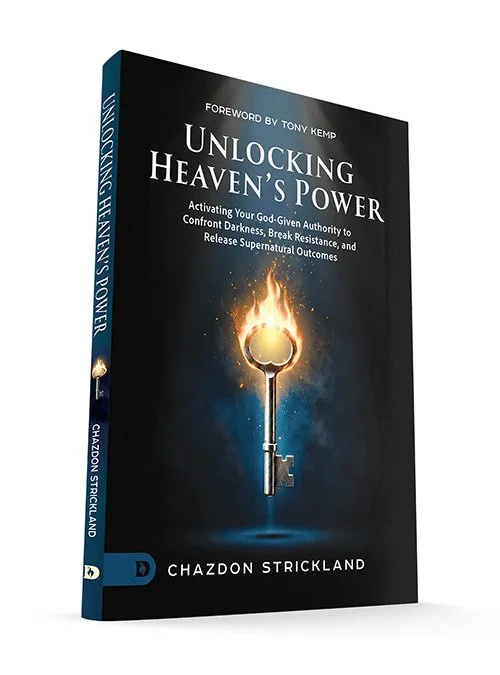
Unlock Heaven's Power and Step Into Your God-Given Authority.
You know God is real—but have you ever wondered why His power seems distant? Have you grown weary of sermons without demonstration, faith without fire, and promises without manifestation? Deep down, you sense there must be more than surviving spiritually—more than hoping breakthrough will someday come. You were never meant to live a powerless Christian life.
What if the very authority you've been praying for has already been given to you? What if heaven is waiting not to descend--but to be released through you?
Through years of ministry and a life-marking encounter on Mount Carmel--the very place where fire once fell—Chazdon Strickland uncovered a powerful truth: when Jesus declared "all authority," He meant it. That authority is not symbolic. It is legal, complete, and delegated. You are not waiting for victory—you enforce it. You are not begging for power—you steward it. It's time to move from passive belief to bold demonstration, always revealing Jesus at the center.
As you turn these pages, you'll discover how to:
Activate resurrection life to see healing, deliverance, and breakthrough flow through you.
Partner with heaven's purposes--understanding the role of angels and spiritual alignment.
Dismantle fear, deception, and counterfeit power with biblical discernment.
Embrace your restored dominion and walk confidently in Christ's delegated authority.
Steward grace as the fuel that keeps power pure and effective.
The cross stripped the enemy of authority. Darkness only prevails where truth isn't enforced. You are seated with Christ—authorized to advance His Kingdom. Stop explaining power away. Walk in it. Heaven's fire still falls. Build the altar.