
Was America Founded as a Christian Nation? The Supreme Court & America’s Prodigal Return
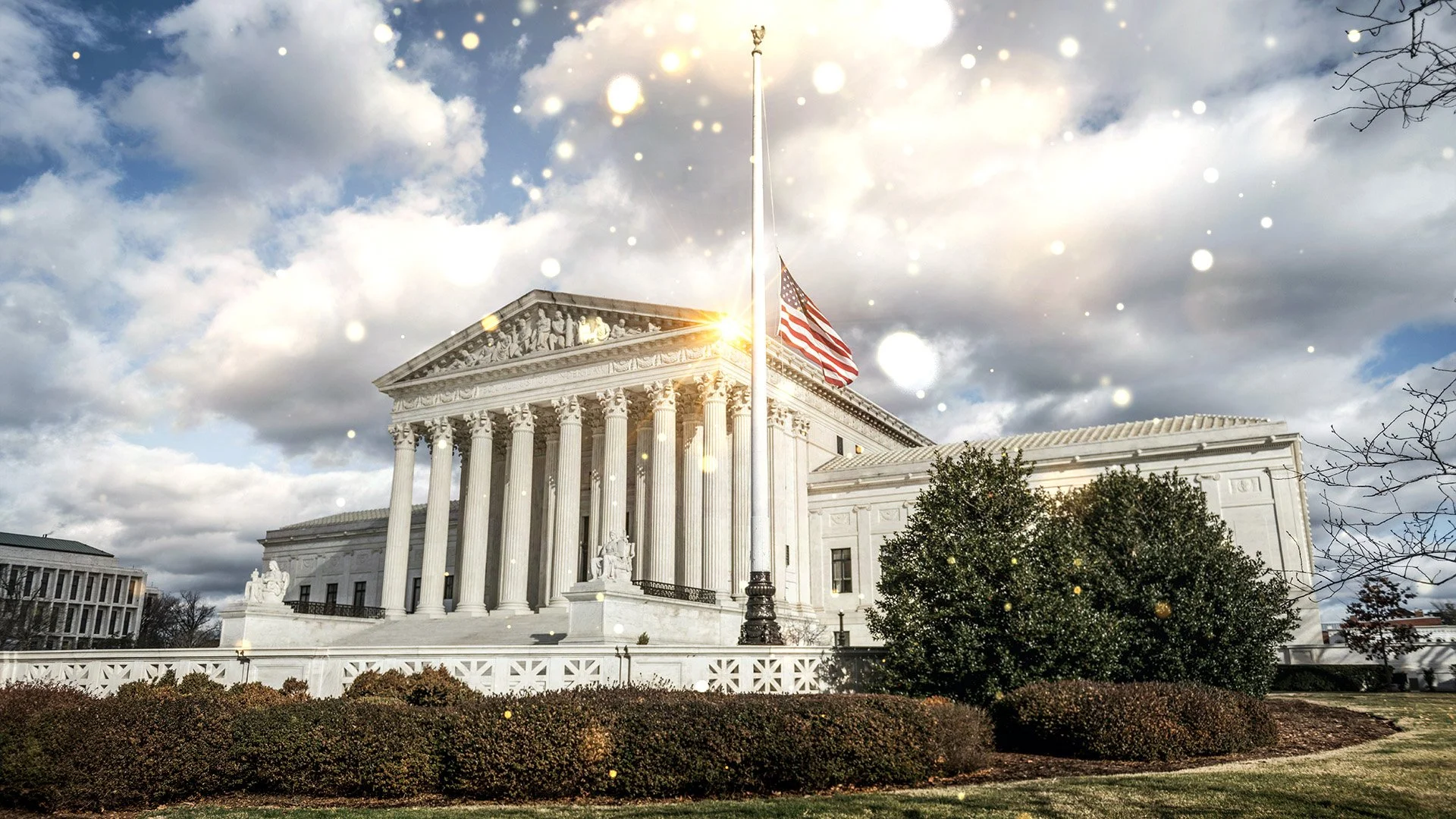
In 1811, the architect of the Constitution, President James Madison, appointed Justice Joseph Story to the Supreme Court.
Justice Story served on the Court for 34 years, was a professor of law at Harvard, was instrumental in opposing the slave trade in the Amistad case, and wrote the famous Commentaries on the Constitution of the United States.
Story explained at Harvard that Christianity lies at the foundation of our nation:
[T]here never has been a period of history, in which the Common Law did not recognize Christianity as lying at its foundation.
In his Commentaries on the Constitution, Justice Story observed the correlation between free government and religion:
It yet remains a problem to be solved in human affairs, whether any free government can be permanent, where the public worship of God, and the support of religion, constitute no part of the policy or duty of the state in any assignable shape.
Consider also Story’s public statement explaining our governmental structure from “A Familiar Exposition of the Constitution of the United States”:
We are not to attribute this prohibition of a national religious establishment [in the First Amendment] to an indifference to religion in general, and especially to Christianity (which none could hold in more reverence than the framers of the Constitution)….
Probably, at the time of the adoption of the Constitution, and of the Amendment to it now under consideration, the general, if not the universal, sentiment in America was, that Christianity ought to receive encouragement from the State so far as was not incompatible with the private rights of conscience and the freedom of religious worship.
Any attempt to level all religions, and to make it a matter of state policy to hold all in utter indifference, would have created universal disapprobation, if not universal indignation. (Emphasis mine.)
The Supreme Court’s Church of the Holy Trinity Opinion
Other compelling evidence of the Christian foundation of our nation is found in the famous 1892 Supreme Court case, the Church of the Holy Trinity. The case provides proof after proof of the Christian roots of the nation. One hundred years after our founding, the Supreme Court continued to explain that: “this is a religious nation”; “[w]e are a Christian people”; and “this is a Christian nation.”
The Supreme Court continued:
Christianity, general Christianity, is, and always has been, a part of the common law…. Not Christianity with an established church…but Christianity with liberty of conscience to all men.
The Supreme Court again repeated the truth from our founding that Christianity is part of the common law:
It is also said, and truly, that the Christian religion is a part of the common law….
These are just some of the principles of our nation’s founding. Of course, there is a difference between principles and applications. Pure principles do not necessarily produce pure applications. And likewise, impure applications do not prove that principles are impure.
Is Our Court—Our Nation—Living in a Foreign Land?
When we read these statements from Chief Justice John Jay, Justice Joseph Story, and the Supreme Court, it may sound foreign to our current legal culture. If that is the case, then perhaps we might consider whether, legally speaking, we have left the native soil of our Father’s House and traveled to a foreign land.
Under the errant leadership of our Supreme Court, it appears that we have traveled to a distant land, followed foreign gods, adopted foreign morals, and immersed our-selves in wild living. When the prodigal son left home, he did not sojourn to a neighboring village. Rather, he traveled to a distant land with foreign laws and morals.
When Did the Supreme Court Depart the Father’s House?
We know when the prodigal son left his father’s house, but when did the Supreme Court breach our national relationship with Him?
Well, that is a difficult question because it is both legally and spiritually discerned. It likely occurred by degrees beginning in 1947 and fully fractured in 1962.
In 1947, the Supreme Court decided the Everson v. Board of Education case. In this case, they reviewed the question of whether the transportation of children to a religious school on buses that transported all children to all schools was an unconstitutional law respecting an establishment of religion. The Court properly said that the law was not unconstitutional because the students were transported to and from both religious and secular schools and the law applied equally to both sets of students.
However, in deciding the case, the Supreme Court made a tragic misstatement that became a ticking time bomb of precedent. The Court falsely claimed:
The First Amendment has erected a wall between church and state. That wall must be kept high and impregnable. We could not approve the slightest breach.
The Court was wrong. The phrase “wall of separation between church and state” is not in our Constitution. The concept came from an 1802 private letter from Thomas Jefferson to the Danbury Baptists in Connecticut who were concerned that the federal government might merge with one Christian denomination. Jefferson’s letter did not say that God was separate from our government, but rather that a wall was intended to prevent the federal government from establishing one denomination as our official national church. It is also important to recognize that when the letter was written in 1802, the established church of the State of Connecticut was the Congregational Church, and it remained so until 1818.
The Everson decision arrived at the right result: the religious students and parents won. However, the decision planted a deceptive seed that grew into a national perversion of our proper governmental relationship with God.
In addition to writing the “Danbury Baptists Letter,” Jefferson was also the primary author of the Declaration of Independence that recognized God is the One who created us, gave us our rights, including the right to exist as a nation. Moreover, he warned us:
[c]an the liberties of a nation be thought secure when we have removed their only firm basis, a conviction in the minds of the people that these liberties are the gift of God?
Clearly, Jefferson understood the importance of our national relationship with God.
Everson Errantly Produced the Evil of Engel
Fifteen years after Everson, the Supreme Court in Engel v. Vitale (1962) sought to determine whether a local education board’s policy requiring teachers to lead students in voluntary prayer at the beginning of each school day violated the US Constitution. The prayer stated:
Almighty God, we acknowledge our dependence upon Thee, and we beg Thy blessings upon us, our parents, our teachers and our Country.
The Supreme Court’s holding in Engel was wrong in at least two respects. First, the prayer policy in Engel did not amount to an establishment of religion, whether at the federal, state, or local level. It was a voluntary prayer for children, not an establishment of a religion. Second, the First Amendment prohibited establishments by the federal government but allowed them by state and local governments. Opponents of our national relationship with God falsely claim that the First Amendment was made applicable against the states by the Fourteenth Amendment but that is not consistent with the text and meaning of the Amendment.
The ruling in Engel was not only legally errant, but it was spiritually tragic. Our founding documents evidence that God is the One who formed us as a nation, gave us our rights, protected and prospered us. Yet in 1962, our Supreme Court breached our relationship with Him and said that government could not offer children the opportunity to voluntarily pray to Him. This breach was not required by our laws, and it set us on a course away from God to a foreign country.
Back to the story of the prodigal son. He took his wealth, left the father’s house and set off for a far country where he engaged in all sorts of wild living. Soon enough the consequences of his prodigal living caught up with him. He was not growing his wealth, but squandering it, and when a famine hit—and they always do—he was in no position to survive. His friendships were all built on his money, so his “friends” left him right after his money did.
Without the wealth of his father’s house, the son’s deficiencies were exposed, and he was confronted with the realities of basic human need. His circumstances led him to work for a person who was nothing like his father. His new master was a cold foreigner who did not care for him and the values of his home country, he only cared what the prodigal could produce. Therefore, the foreign employer put this Jewish prodigal to work in the most dishonorable and un-Jewish of jobs—feeding pigs in the fields.
The son was lower than a pig—a servant to pigs! For a Jewish man, this was particularly dishonoring because pigs are considered unclean. He wished he could eat what the pigs ate but his new boss (contrasted with the loving father of his home) would not grant him even that extremely dishonoring benefit of eating pig slop.
He reached the very end of his journey, lost all favor and blessing on his life. And no one gave him anything. What a miserable and sad state of affairs.
Have We Become Like the Prodigal?
Look around the nation—the United States of America. What do you see? What you see will tell you whether we are in the Father’s House or in a foreign country, whether we are still running away or whether we are on our way home.
Our proximity to the Father is not determined by His movement but by ours. He has not moved. We have.
If we find ourselves in a rainstorm, we shouldn’t curse the Father, but rather we should reorient ourselves back under His umbrella.
He never left us. We left Him.
The Supreme Court is at fault for leading us away from the Father. But we followed them and so we bear guilt as well. We did our best to forget about our Father, but He never forgot about us. All these decades, while we were in a foreign land partying with hookers, He remained faithful to us—and He is still faithful to us today.
Every night, our Father thinks about us.
Every night, He walks out on the front porch and weeps for us. His eyes search the horizon hoping we crest the hill on the road home.
His heart is broken.