

We need a framework for this. Because the hunger is real, and the counterfeits are sophisticated.
So how do you recognize when heaven has genuinely crashed in—when you’ve encountered something that actually originates from God and not from deception, imagination, or demonic counterfeiting?
There are four marks. Not every encounter displays all four with equal intensity, but across the full arc, authentic encounters carry these characteristics:
Mark 1: God Shows Up Uninvited
Genuine heavenly encounters come uninvited. You don’t achieve them through technique, meditation, or spiritual effort. You don’t earn them through the right prayer posture or the right words spoken into the atmosphere. They arrive as interruptions. Holy interruptions.
The counterfeit spirituality market is built entirely on technique. Meditate correctly, breathe correctly, fast correctly, visualize correctly—and you can access the spiritual realm. That’s the promise. But it’s backward from how God works. When God interrupts, He doesn’t need your permission or your methodology. He just shows up. Blake Healy wasn’t in some special spiritual state when he saw a trafficking survivor as the Father sees her. He was praying. As a 15-year-old at a conference, Healy wasn’t seeking a vision—he was just sitting in a meeting when heaven broke through.
Mark 2: The Fruit Points Toward Jesus
Genuine encounters from heaven make you more interested in Jesus, not more interested in the experience itself. They produce fruit aligned with Scripture: love, joy, peace, patience, kindness, goodness, faithfulness, gentleness, self-control.
If an encounter makes you more interested in having more encounters, be cautious. If it makes you feel spiritually superior. If it creates a hunger for spiritual experiences more than a hunger for God Himself. If it moves you toward seeking and not toward prayer and worship—those are warning signs.
Some of the most dangerous counterfeit spirituality looks beautiful and sounds true, but it produces the opposite fruit. It makes you less stable, not more. It makes you less grounded in your actual life and calling. It makes you more focused on the supernatural realm than on the Father’s will in your present circumstances.
But Blake Healy’s encounters with the Father’s perspective didn’t make him hungry for more visions. They made him grounded in God’s goodness. They made him more certain of the Father’s heart. They made him spend his entire life expressing that goodness to others.
Becca Greenwood, ministering in Nairobi in 2013, found her taxi surrounded by city buses in the middle of a violent dispute between bus and taxi drivers. With no human solution, she prayed, “Lord, send an angel to deliver us from this situation.” A kind and wise elderly man appeared behind the taxi, calmly directed her driver through the gap to safety, and then vanished. The taxi driver, stunned, said: “You ladies pray different than what I have been taught. You prayed, the Lord sends an angel, and we are delivered out of danger!” That encounter opened a door to the gospel.
Mark 3: Scripture Is the Plumb Line
The New Testament gives us this test:
“Beloved, do not believe every spirit, but test the spirits to see whether they are from God, for many false prophets have gone out into the world. By this you know the Spirit of God: every spirit that confesses that Jesus Christ has come in the flesh is from God, and every spirit that does not confess Jesus is not from God…” (1 John 4:1-3).
This isn’t the only test Scripture offers. Deuteronomy 13 tells us to evaluate prophecy based on whether it calls people toward idolatry or away from God. Matthew 7:20 tells us to evaluate by fruit—“you will recognize them by their fruits.” First Thessalonians 5:21 tells us not to despise prophecy but to “test everything; hold fast what is good.”
Not everything supernatural is from God—and the test is never how something feels, but what it says about Jesus and where it leads. Test it against Scripture. Genuine encounters with heaven are never in conflict with Scripture. They may stretch your understanding. They may challenge your assumptions. But they won’t tell you Jesus is insufficient, or that there’s a legitimate spiritual path outside of Him, or that chakras or spirit guides or reincarnation are roads to God. If an encounter points away from Jesus, it’s pointing you somewhere dangerous.
Mark 4: It Sends You Back into Your Life
The fourth mark is the one where many well-meaning believers get derailed. A genuine encounter sends you toward your calling, not toward chasing more encounters. It clarifies and launches. It doesn’t addict.
Go back to Joseph, Daniel, Peter, and Philip. Each of their encounters had the same result—they didn’t become more interested in receiving the next vision. They became more committed to their current calling. Joseph used his gift to preserve a nation. Daniel devoted himself to intercession. Peter became a fisher of men. Philip became an evangelist to the unreached.
But real life-direction isn’t just about calling—it’s about being personally known and personally loved. My friend Mike Olsen, who experienced heaven firsthand during a near-death experience, heard angels singing over him: “Mike’s coming home.” Not as generic spiritual experience, but as a deeply personal welcome. The God who knows you by name. The God who sings over your future. That encounter wasn’t giving him information—it was giving him identity. It was sending him forward into life with the certainty that he was seen, known, and loved by the Father.
My own experience of this is less dramatic but no less real. During my late wife Lynette’s illness, I prayed in two directions at once—for her healing, and to be surrendered to God’s will for whatever future He had for me if she went home to heaven. I wasn’t chasing anything. I was simply surrendering.
In June 2024, I attended a conference and connected with a couple who had walked through similar seasons of trauma and loss, found each other, and remarried. They prayed for me. In the ten days that followed, nine different people—none of whom knew each other—sent me essentially the same prophetic word: your future wife doesn’t know you’re looking for her, but you’re going to meet her soon. One prophetic word from one person requires testing. Nine consistent words from nine independent voices across ten days is a pattern that transcends coincidence.
Follow Jesus, not the experience—and in following Him in surrender, the encounters find you. I met Nicole. We were married. Everything those nine voices described came to pass, more rapidly than I would have thought.
The goal of a genuine encounter isn’t spiritual celebrity or special status. The goal is alignment. Alignment with heaven’s priorities. Alignment with Jesus’s mission. Alignment with God’s will for your life. And often, the deepest alignment comes not when we seek encounters, but when we surrender to the God who initiates them.
Holy Interruption Versus Spiritual Chasing
There’s a radical difference between being interrupted by heaven and chasing heaven.
Holy Interruption looks like this: You’re living your ordinary, faithful life. You’re praying. You’re serving. You’re walking in obedience. And then—unsolicited, unexpected—heaven breaks in. A vision comes. A dream arrives. A prophetic word appears. You don’t know why now. You didn’t do anything to trigger it. It just came. And when you test it, when you process it, when you let it settle—it sends you deeper into prayer and obedience. Deeper into Jesus. Your calling becomes clearer. Your faithfulness deepens. But you don’t become obsessed with the encounter. You become more committed to the Person encountered.
Spiritual Chasing looks like this: You have an encounter. It’s real. It moved you. But instead of letting it launch you into deeper obedience, you become fascinated with the encounter itself. You start seeking techniques to reproduce it, cultivating hunger for the next one. And the more you chase, the hungrier you become. The experience becomes more important than obedience. The next encounter becomes more important than the current calling. Prayer becomes technique. Faithfulness becomes performance. And you’ve opened a door to counterfeits.
My credibility on this subject isn’t theoretical. I’ve spent eight years interviewing many near-death experience survivors, and years as a publishing professional working with people who have received genuine prophetic words, genuine angelic encounters, genuine supernatural experiences—and I’ve watched some of them flourish in deeper obedience and others spiral into spiritual compulsion. The experiences from God didn’t make them feel special. They made them feel responsible. They didn’t create a hunger for the prophetic gift. They created a hunger to pray harder and obey faster.
Whose Voice Is This? The Speaker Test
There’s one more test worth running. When you encounter the supernatural—a vision, a dream, an angelic visitation, a prophetic impression—ask a simple question: Whose voice is this?
John 10:27 gives us the standard: “My sheep hear my voice, and I know them, and they follow me.” Jesus is saying His people recognize His voice. There’s a familiarity. When He speaks, you know it’s Him.
In my work with NDE survivors, I’ve heard numerous accounts where the person met “a being of light” or “an angel” or “a wise presence.” And in some of those accounts, the being teaches things that contradict Scripture. But the person reports feeling such peace, such love, such assurance that they didn’t question it. Here’s the danger: Demonic deception often comes wrapped in light and peace. It’s not always dark and chaotic. Sometimes it’s beautiful. Sometimes it’s gentle. Sometimes it feels like home.
So the Speaker Test is this: Does the voice sound like Jesus? Not: Does it feel good? Does it feel peaceful? Does it feel loving? But: Does the message align with the Jesus of Scripture? Does the teaching match His kingdom values? Does the call direct you toward Him?
Genuine Encounter Always Leads Somewhere
The Bible is consistent on this point: genuine encounter with God is never a destination. It is always a launching pad. No one in Scripture receives a vision, an angelic visitation, or a significant revelatory experience and simply sits with it as a spiritual possession. Every encounter in Scripture moves. It sends. It commissions. It changes the direction of a life.
Consider Isaiah 6. The prophet sees the Lord “high and lifted up,” the hem of His robe filling the temple, seraphim crying, “Holy, holy, holy.” Isaiah’s immediate response is undoing—“Woe is me! For I am lost; for I am a man of unclean lips…” (Isaiah 6:5). This is not spiritual tourism. This is a man encountering the actual holiness of God and being broken by it. But the encounter doesn’t end there. The coal touches his lips. His guilt departs. And then the voice: “Whom shall I send, and who will go for us?” And Isaiah answers: “Here I am! Send me” (Isaiah 6:8). The entire arc of that encounter—from vision to undoing to cleansing to commissioning—takes less than a chapter. Heaven didn’t give Isaiah a spiritual experience to treasure. Heaven gave Isaiah a mission.
Look at what happened with Cornelius in Acts 10. An angel appears to him while he prays and gives a single directive: send for Peter (Acts 10:4-5). Simultaneously, Peter receives a vision preparing him to go. Two people, two encounters, coordinated by heaven for one purpose—and the fruit is the gospel reaching the Gentiles. Real encounter always moves toward something.
John on Patmos receives the most elaborate visionary encounter in all of Scripture. He sees the risen Christ in blinding glory—“…his eyes were like a flame of fire, his feet were like burnished bronze, refined in a furnace, and his voice was like the roar of many waters” (Revelation 1:14-15)—and he falls at Christ’s feet “as though dead” (Revelation 1:17). But Christ lifts him and gives him a commission: “Write what you see in a book and send it to the seven churches…” (Revelation 1:11) John doesn’t sit in the afterglow. He picks up a pen and writes to seven specific churches. That’s what encounter does.
Shortly after Nicole and I were married—I’m not certain of the exact timing—I had a dream. I saw Lynette in heaven in what felt like a nursery. There were two babies. One I understood to be Esther Grace—the child Lynette had miscarried the year before her diagnosis, and whom she named. Lynette was nursing her, which is exactly the kind of thing Lynette would be doing; she and I had ten children together and she was never more herself than when she was mothering. The second baby in the room was a boy. I had a quiet sense—nothing dramatic, nothing thundering—that Lynette was watching over the son Nicole and I were going to have. We had a son. His name is Parker James.
Heaven is real—and it should change how you live today. Every encounter in Scripture says as much. The goal is never to collect experiences. The goal is to be shaped by God’s initiative into faithfulness. That’s what real encounter does. It doesn’t leave you sitting in the afterglow. It leaves you walking through a door you didn’t know was there.
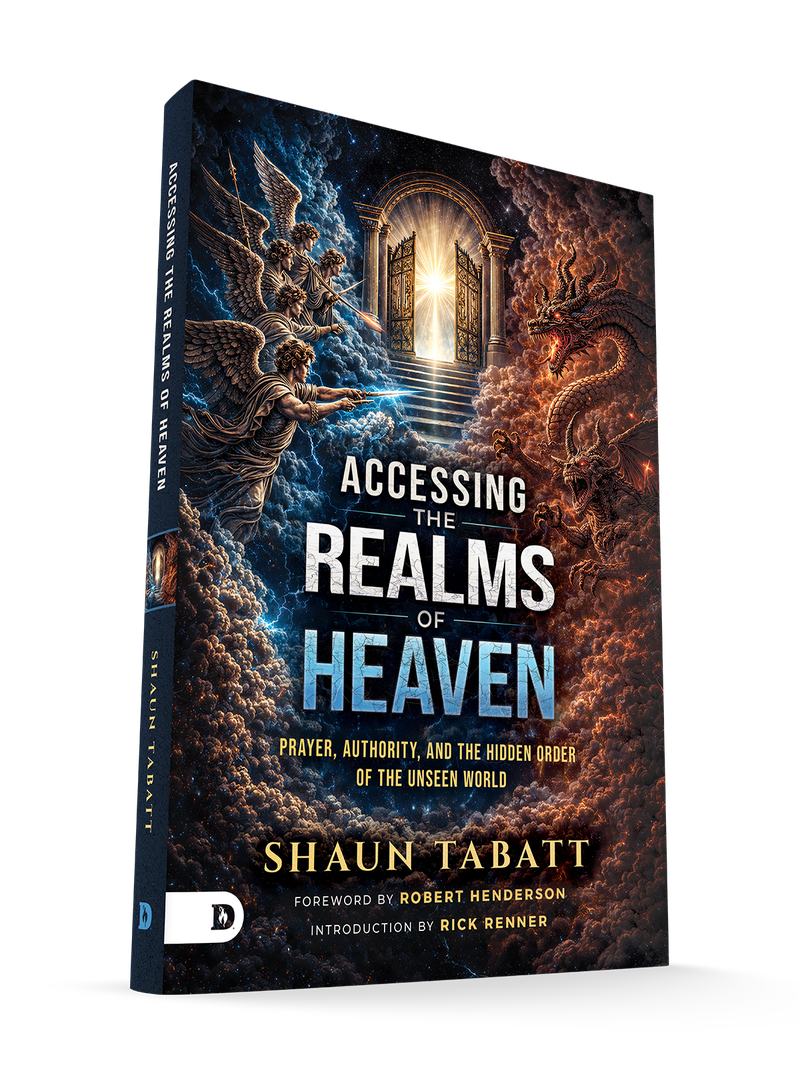
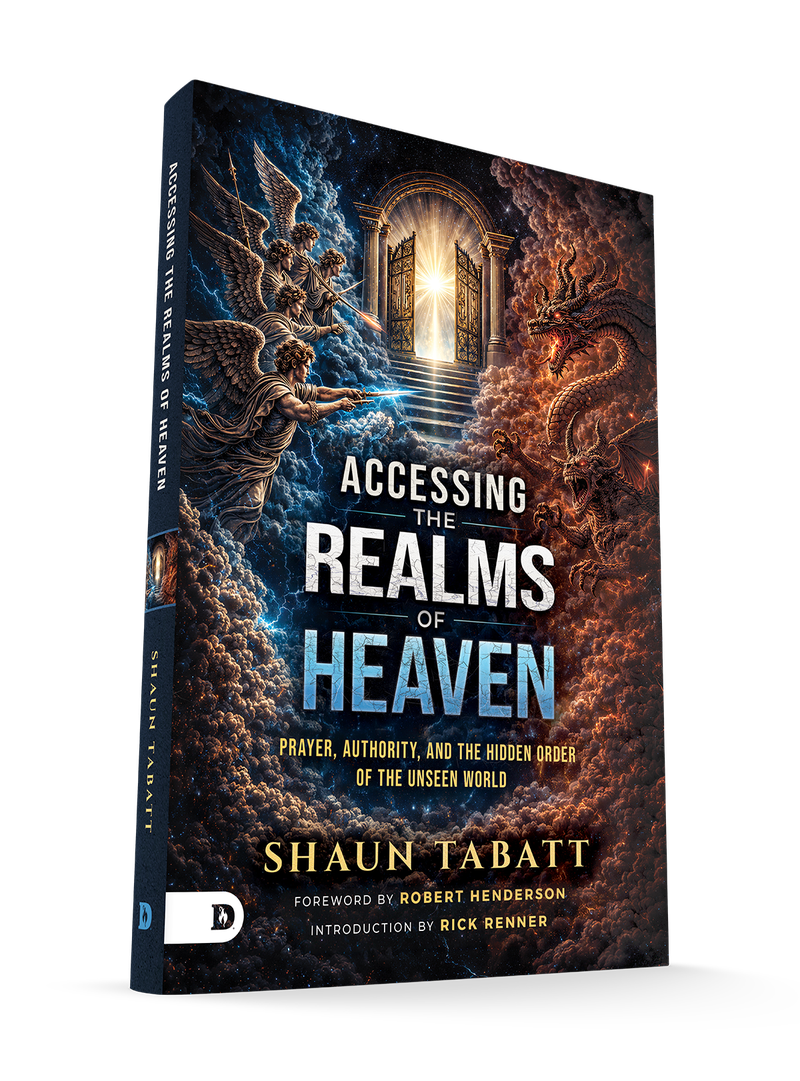
Step into confident, Scripture-grounded authority—and leave fear, confusion, and striving behind.
Have you ever wondered why some prayers seem delayed while others break through? Or questioned whether your spiritual experiences are truly from God?
You’re not alone—and you’re not meant to live in confusion.
In this powerful and deeply clarifying guide, bestselling author Shaun Tabatt reveals a truth many believers have missed: the unseen world is not chaotic—it is ordered, governed, and anchored in God’s authority.
Through years of research, ministry conversations, and personal experience shaped by grief and unanswered prayer, he shows you that prayer is not about striving upward, but learning to live from the place where God already reigns.
In Accessing the Realms of Heaven, you’ll discover how to:
Understand the biblical structure of the unseen realm
Discern God-led encounters vs. counterfeit experiences
Navigate dreams, visions, and spiritual impressions biblically
Recognize spiritual resistance without fear or obsession
Stand in your identity and authority in Christ
You are not called to strive for access—you are invited to rest in it! It’s time to stop praying from confusion and start living from heaven’s perspective.