

Something has shifted in the way our culture talks about death, consciousness, and the afterlife.
Near-death experiences are no longer a fringe topic discussed in hushed tones—they’re on mainstream podcasts, bestseller lists, and primetime interviews. And now psychedelics have entered the conversation, with researchers and spiritual seekers alike claiming that substances like DMT and psilocybin open doors to the same territory NDEs explore. Both phenomena produce experiences that feel real, meaningful, and unmistakably spiritual. Both are reshaping what millions of people believe about God, death, and what comes next. And both require the same question: What does someone come back believing about Jesus?
Why Altered States Feel Revelatory
Dr. Bruce Greyson, psychiatrist and professor emeritus at the University of Virginia, has spent 50 years studying near-death experiences. He was trained to believe that “the mind is what the brain does and when you die that’s just it.”
Then he encountered a case that changed everything.
A woman named Holly had overdosed and been brought to the emergency room, completely unconscious. While she lay unresponsive, Greyson stepped down the hall to speak with her roommate, Susan. Holly was admitted to the ICU overnight. The next morning—still groggy—she described in precise detail the conversation Greyson had with Susan: what they were both wearing, where they were sitting, even a stain on Greyson’s tie that no one but Susan could have seen—his lab coat covered it except during that one conversation.
“Nothing in my life had prepared me for this.”
After 50 years as a psychiatrist, Greyson knows the difference between genuine phenomena and hallucination. “I know what mental illness is like. I know what hallucinations are like and they’re not at all like near-death experiences.” What he’s witnessed repeatedly is people who were clinically unconscious—sometimes dead—yet describe their consciousness as “more vivid than ever before,” with memories “sharper than memories of other events at the same time in their life, decades after the event.”
This raises a pressing question: If altered states can produce such vivid, coherent, and sometimes verifiable experiences, what are we dealing with?
The data suggests something real is happening. Writing in Christianity Today, Joe Welker notes that “many users have reported their psychedelic trips as among the most meaningful experiences of their lives, often rivaling the birth of a child or death of a parent.” Research by Christopher Timmermann and colleagues shows that psychedelic use produces persistent shifts in metaphysical beliefs, with changes lasting months after a single experience.
We need a framework for this.
Suggestive, Significant, But Not Self-Authenticating
When we evaluate NDEs and psychedelics, three claims matter:
Suggestive: Both phenomena suggest there is more to reality than the material. The experiences point beyond themselves to a transcendent realm. This is not dismissible.
Significant: The effects are real and documented. Aftereffects persist. Worldview changes are measurable. People rate these experiences as life-defining. The significance is not in question.
Not Self-Authenticating: Here is the critical turn. “Real” and “meaningful” are not the same as “reliably revelatory.” The meaning-making system is operating under abnormal conditions—whether it’s a brain near death, consciousness in trauma, or neurochemistry altered by a substance. Under such conditions, the mind is highly suggestible, the sense-making apparatus is compromised, and the person cannot trust their own interpretive capacity the way they would in normal consciousness.
This is not to say the experience didn’t happen. It is to say the interpretation requires testing.
Even Greyson, who has spent 50 years studying this phenomenon, refuses to overreach. When asked, “Is it safe to say that there is life after this life?” his response was: “As a scientist, I can’t say we’ve proven that. But as a person who hears these stories, I find it hard to deny that there seem to be so many cases where people are pronounced dead and yet seem to be thinking clearly and in fact more vividly than ever before.”
He didn’t claim proof. He said the evidence points. He said he struggles to find another explanation. But he refused to cross the line into certainty about interpretation. If one of the world’s leading NDE researchers won’t go further than that, neither should we.
The NDE Research Landscape and Contested Interpretation
Bruce Greyson developed the NDE Scale in 1983, and it is still the foundational methodology in NDE research. It measures the depth and breadth of NDE phenomena in a standardized way—essential for moving beyond pure anecdote. That methodology has allowed researchers to accumulate real data. But the data reveals something important: the NDE field has no consensus on mechanism or interpretation.
A 2025 systematic review by Miquel-Sendra and García-Alandete examined the aftereffects of NDEs across the literature. They found positive aftereffects: increased spirituality, reduced fear of death, greater compassion. But they also found negative aftereffects: depersonalization, relational difficulty, trouble reintegrating into normal life. The picture is not uniformly positive. Some people are helped. Some are harmed.
Barreto’s 2025 bibliometric review shows theoretical fragmentation across 50 years of NDE literature. No consensus on what causes the experience. No agreement on whether consciousness actually leaves the body or whether the brain generates the phenomena under extreme stress. The field is contested.
This matters. If you’re a reader whose loved one had an NDE, or you yourself have had one, it’s important to know that NDE research has not settled these questions. The phenomena are real. The research is legitimate. But interpretation remains open—which is precisely where biblical discernment becomes essential.
Here’s another critical point: not all NDEs point the same direction spiritually.
On my podcast, Adam Blai walked through why mediums cannot be contacting deceased loved ones. Adam works from a Catholic framework, so his categories include purgatory; charismatic and Protestant readers will hold different views about what happens between death and the final resurrection. But watch the logic he runs. “A saint in heaven is not going to come through a medium because that’s forbidden in the Bible. A soul in purgatory is on the slow escalator heading toward heaven—the last thing they want is to jump off and incite mortal sin in someone. So what do you have left? Demons.”
Whatever your view of the afterlife’s intermediate states, Adam’s logic of elimination holds: the genuine dead are not available for medium contact. What presents itself as a deceased loved one is something else.
This same discernment applies to NDEs. If an experience returns someone to biblical faith—Christ as Lord, Scripture as authoritative, sin as real, judgment as real—then the experience’s truth-orientation is established. But if an experience returns someone to universalism, New Age consciousness, or a theology where Jesus is “one among many,” then something else is at work, regardless of the vividness of the experience.
Isaiah had the same counsel for his generation: “And when they say to you, ‘Inquire of the mediums and the necromancers who chirp and mutter,’ should not a people inquire of their God? Should they inquire of the dead on behalf of the living? To the teaching and to the testimony!’” (Isaiah 8:19-20). The test Scripture always applies is the same: does this lead you toward God’s Word and His people, or away from it?
Greyson himself notes that while NDE features are universal—tunnel experiences, beings of light, life reviews—the interpretation varies. “How they describe it is based on what they’re familiar with, what analogies they’re familiar with.” Culture shapes the metaphors. But it doesn’t shape the direction of spiritual outcome. A person either comes back believing Jesus is Lord or they don’t. That’s the test that matters.
The NDE research landscape is no longer a neutral research environment. It’s become a spiritual marketplace. I’ll show you what that looks like in a moment.
How to Evaluate Testimony from Altered States
The most important thing I want to give you in this article is also the simplest. Four questions:
What do they come back believing about Jesus? Is He the Son of God, Lord, and Savior? Or is He a good teacher, one among many, or absent from the testimony entirely? This is the primary criterion.
What do they come back believing about sin, judgment, and human responsibility? Does the account acknowledge human need for redemption? Or does it embrace a vision of universalism where everyone goes to the same place regardless of their choices?
What do they come back believing about Scripture? Do they emerge affirmed in the authority of God’s Word, or do they come back with the sense that Scripture is incomplete or needs updating?
What fruit does the experience produce over time? Does it lead toward Jesus, prayer, repentance, and transformed obedience? Or does it lead toward spiritual seeking, experience-chasing, dependence on mediums or guides?
Applying the Framework to Named Accounts
Let me apply the four questions to contemporary NDE accounts. For the descriptive structure of an NDE, I work from a nine-point framework I developed in The NDE Conspiracy. It catalogs the typical elements: out-of-body experience, life review, post-NDE effects, and similar phenomena. Readers who want the full taxonomy can find it there.
Felix Halpern’s account A Rabbi’s Journey to Heaven
Halpern’s 2019 cardiac arrest led to clinical death and an extended encounter with Yeshua. Throughout his experience, Jesus reveals Himself as the Son of God and the path to the Father, answering the Jesus question directly. Halpern returns affirmed in Scripture, with his theology of human need and divine redemption intact, and his post-NDE ministry has continued in that same Yeshua-centered direction. The account aligns with biblical cosmology. Passes.
Gabe Poirot’s Account: 18 Days in Heaven
Poirot’s 2021 coma produced an extended experience of heaven. The account names Christ explicitly throughout, anchors itself in Scripture (Poirot actively invites Berean testing rather than asking readers to take the experience on its own authority), engages biblical anthropology, and has borne fruit in pointing people toward Christ rather than into spiritual seeking. Passes.
Dr. Mary Neal’s Account: To Heaven and Back
Dr. Mary Neal is an orthopedic surgeon who was trapped underwater for 30 minutes during a kayaking accident. Her account maintains a Christian framework throughout. Christ is present, Scripture is affirmed, the life review carries the weight of moral seriousness without sliding into universalism. She also describes prophetic knowledge of her son’s future death, which later occurred. That element is theologically complex; it fits within a Christian prophetic framework but is the kind of claim Scripture asks us to test carefully. On the central questions of Jesus, Scripture, and fruit, her account answers consistently. Largely passes.
Jeremy Renner’s Account: A Vague Being
Jeremy Renner had a near-death experience following a snowcat accident on January 1, 2023. In his Oprah interview, he describes the experience as peace, exhilarating love, and what he calls “a collective divinity of love.” He explicitly rejects the idea of God as “some bearded man in the sky” and says he doesn’t want organized religion or anything else dividing him from anyone. There is no clear identification of Christ. There is no engagement with Scripture. Sin and judgment do not appear. The fruit is genuine. He describes deeper love for his family, less anxiety, less attachment to trivial pursuits. But the meaning he’s anchored in is consciousness and connection, not the person of Jesus. The experience is real. The theology is vague. Partial; requires careful handling.
Gabrielle’s Account: The Hand of Jesus
Now consider what happens in the same Oprah interview when Gabrielle, a country singer who flatlined from a brain tumor, describes her experience. “I just almost felt this hand,” she said. “I felt like it was the hand of Jesus and just being like, ‘Nope, not yet. Not yet.’” Same near-death pattern as Renner. Completely different theological destination. Gabrielle names Jesus, returns to a faith framework where Jesus is Lord, comes back with reordered priorities toward family and love, and has continued in that direction since. The contrast with Renner is the framework doing exactly what it’s designed to do. Passes.
Bryan Melvin’s Account: The False Welcoming Committee
Bryan Melvin’s account is a starkly different case. Melvin contracted cholera from contaminated water in Mexico, and as he approached death, what appeared to be a welcoming committee of recognizable figures emerged. Among them was someone who looked like his own living mother, a detail that should have been impossible. In Melvin’s account, “everything shifted.” The familiar figures transformed into serpent-like creatures and one of them eventually took him into hell. The welcome was counterfeit. Demons had posed as deceased loved ones. The initial vision failed every question. No Christ. No Scripture grounding. Deception about the dead that Isaiah 8 explicitly warns against. What rescued the account from full counterfeit was the corrective revelation: Melvin came back believing in hell, in judgment, in the reality of demonic deception, and in the urgency of trusting Christ rather than any spiritual presence offering itself as a deceased loved one. Fails the initial appearance test; passes the corrective test.
The “Being of Light” Cases: Subtle Counterfeit
The hardest accounts to discern are not the obvious counterfeits like Melvin’s. They are the subtle ones: encounters with a vague being of light that has no clear identity, no biblical specificity, no doctrinal content. The being feels loving. The presence feels real. The person returns convinced of universalism (“everyone goes to the same place”), or that Jesus is “too limiting,” or that all religious paths converge. These accounts fail the Jesus question in a quieter way than Melvin’s, but the failure is the same: the experience returns someone to a theology Scripture contradicts.
“Do not quench the Spirit. …but test everything; hold fast what is good” (1 Thessalonians 5:19-21). When someone comes back believing something Scripture contradicts (universalism, the divinity of the self, the irrelevance of Christ), the framework has done its work. The subtle counterfeit is more dangerous than the overt one because it doesn’t announce itself.
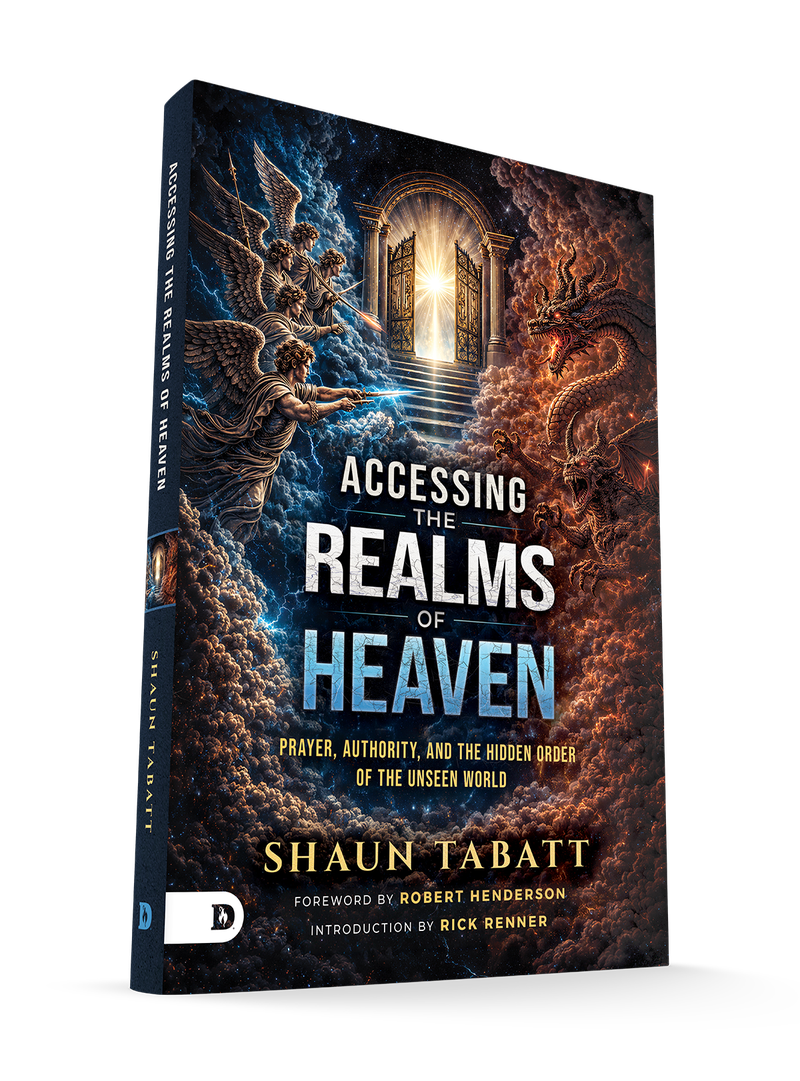
Step into confident, Scripture-grounded authority—and leave fear, confusion, and striving behind.
Have you ever wondered why some prayers seem delayed while others break through? Or questioned whether your spiritual experiences are truly from God?
You’re not alone—and you’re not meant to live in confusion.
In this powerful and deeply clarifying guide, bestselling author Shaun Tabatt reveals a truth many believers have missed: the unseen world is not chaotic—it is ordered, governed, and anchored in God’s authority.
Through years of research, ministry conversations, and personal experience shaped by grief and unanswered prayer, he shows you that prayer is not about striving upward, but learning to live from the place where God already reigns.
In Accessing the Realms of Heaven, you’ll discover how to:
Understand the biblical structure of the unseen realm
Discern God-led encounters vs. counterfeit experiences
Navigate dreams, visions, and spiritual impressions biblically
Recognize spiritual resistance without fear or obsession
Stand in your identity and authority in Christ
You are not called to strive for access—you are invited to rest in it! It’s time to stop praying from confusion and start living from heaven’s perspective.