

When the court mode is no longer serving you, when you’re stuck presenting cases and never moving forward, test it against Scripture.
Scripture doesn’t call us to live in the courtroom. It calls us to “with confidence draw near to the throne of grace” (Hebrews 4:16). The modes of prayer are real and biblical. But Scripture clarifies which mode is for what season, and which one is the destination.
Let’s make sense of this. Robert Henderson teaches that prayer operates in three modes. They are not three different theologies. They are three different postures within one relationship with God.
The Father mode is intimacy, rest, the normal state of the believer’s ongoing relationship with God. You come as a child comes to a parent, not in fear, not in lawsuit, but in trust. In Father mode, you’re not presenting a case. You’re resting in relationship. The Judge mode is legal proceedings.
Henderson distinguishes the three approaches by the realm each one opens: “Approaching God as Father brings us into the secret place and approaching Him as Friend opens the Council of the Lord, coming before Him as Judge gives us access into the Courts of Heaven.” You approach God as Judge when you need verdicts rendered, when you need accusations silenced, when legal ground needs to be cleared. And here is the pastoral implication: when something is pushing back against your prayers—when you sense resistance you cannot pray through—that is the moment to shift modes. Not because Father-relationship has failed, but because what the moment now requires is a verdict, not a conversation.
Mature prayer moves through the court when necessary, gets the verdict, and then keeps going. It presses through the courtroom into the throne room itself. It moves from Judge mode into Father mode. From legal victory to intimate presence.
But all three modes assume the same thing: that access is real, legitimate, and available—and that not every door into the supernatural leads to the same place.
Access Versus Intrusion: The Critical Distinction
This is the distinction the whole article rests on. Heaven has a real court and a real throne, but they are not open to intrusion. They open to access. And access comes through one Door: Jesus, by faith, through prayer.
Think of it this way. A king’s throne room is not a public square. You don’t wander in. You don’t find a side door. You don’t manufacture your own invitation. You come because the king himself has made a way—and you come through the door he designated, not the one you prefer.
Every counterfeit spiritual system—every medium, every psychic, every astral projection technique, every New Age portal—is an attempt to reach the throne room through a door the King never opened. That’s not access. That’s intrusion. And the unseen realm responds to intrusion very different from how it responds to access.
The distinction matters because heaven is real. The court is real. The throne is real. Which means the wrong door is also real—and what waits behind it is not the Father.
What Gives the Enemy Legal Ground?
Not every sin requires a court case. This is where many intercessors get confused.
When you confess a sin—“I lost my temper, I’m sorry, Lord, forgive me”—that sin is covered. It’s under the blood. The verdict is in: Forgiven.
But iniquity is different.
Iniquity is the pattern, the bent. It is not an isolated failure but a habitual tendency toward a particular sin. It is the groove worn by repeated choices. And iniquity creates legal ground, a case that the enemy can bring before the court.
Robert Henderson identifies four ways iniquity attacks God’s purposes in our lives: it gives the enemy a legal right to tempt us in a given area; it fashions our identity; it destroys destinies; and it allows the enemy to build a case against us in the Courts of Heaven. In 1 Peter 5:8, believers are warned: “Be sober-minded; be watchful. Your adversary the devil prowls around like a roaring lion, seeking someone to devour.” That word adversary is the Greek word antidikos, and it means “one who brings a lawsuit.” Satan’s primary role before the court is prosecutorial. He is the one bringing cases. Iniquity is his evidence.
Scripture shows us what this looks like. In Zechariah 3:1-5, the prophet sees Joshua the high priest standing before the angel of the Lord, while satan stands at his right hand to accuse him. Joshua’s garments are filthy. The accusation is real. The case is open. But then the verdict comes: “And the Lord said to Satan, ‘The Lord rebuke you, O Satan! The Lord who has chosen Jerusalem rebuke you! Is not this a brand plucked from the fire?’” (Zechariah 3:2). The filthy garments are removed. Clean garments are placed on him. Joshua is reclothed, repositioned, restored—not because he argued his own case, but because God Himself answered the accuser and applied the cleansing.
This is the court’s proper function. The accuser brings a case. God renders a verdict. And the verdict is not condemnation—it is cleansing. The believer who enters the court covered by the blood of Jesus does not stand there alone. The One who rebuked satan in Zechariah 3 is the same One who intercedes for us now at the right hand of the Father.
Job 1 and 2 show us the same structure twice. The divine assembly convenes. The adversary is present—not because God is unaware, but because the heavenly court is a real judicial venue where cases are brought and God renders verdicts as the sovereign Judge. Satan can only go as far as God permits. What looks like chaos on earth is bound deliberation from above.
Augustine put his finger on exactly this. He wrote of Job: “The devil asked for a holy man, to tempt him; and he received.” And then, in the same breath, the contrast: “The apostle asked that the thorn in the flesh might be taken from him, and he received not.” Both prayers were heard. Both got an answer. But Augustine’s conclusion is sharp: “The apostle was heard for salvation, though not for his wish: the devil was heard for his wish, but for damnation.” God was not outmaneuvered in Job. He was governing. And Job’s endurance under permitted suffering became the very thing that defeated the accuser’s purpose.
But here is the liberation—if iniquity creates a case, clearing the iniquity clears the case. This is the legitimate work of the court, not earning forgiveness (that’s confession), but clearing legal obstruction so the believer can move into the Father’s presence without hindrance.
The Holiest of Holies As the Hinge Point
The court and the throne are not in different locations. They are in the same location: the holiest of holies, the inner sanctuary of heaven. But your access to that place depends on your posture and purpose.
When you approach as a defendant, acknowledging accusation, presenting your case, getting a verdict, you are engaging the court dimension of the holiest of holies.
When you approach in restored relationship, with legal ground cleared, with accusations answered, with the blood of Jesus as your access, you enter into intimate presence with the Father. You are no longer in court mode. You are in Father mode.
The book of Hebrews makes this explicit. “Therefore, brothers, since we have confidence to enter the holy places by the blood of Jesus, by the new and living way that he opened for us through the curtain, that is, through his flesh…let us draw near with a true heart in full assurance of faith…” (Hebrews 10:19-22).
This is what makes Jesus’s ascension the completion of what the old tabernacle system only prefigured. Jesus did not sit down in a courtroom. He sat down “at the right hand of God” (Colossians 3:1). At the right hand. In the position of authority. At the throne.
And Hebrews 4:14-16 brings it all together:
Since then we have a great high priest who has passed through the heavens, Jesus, the Son of God, let us hold fast our confession. For we do not have a high priest who is unable to sympathize with our weaknesses, but one who in every respect has been tempted as we are, yet without sin. Let us then with confidence draw near to the throne of grace, that we may receive mercy and find grace to help in time of need.
Jesus has “passed through the heavens.” He went through the courtroom. He passed through every level of heavenly authority. And He sat down at the throne. At the throne of grace. And He opened that access for us.
So the entire point of the court, when properly understood, is not to live in the court. The court clears your legal case so you can access what’s beyond: the throne of grace itself. Presence. Father. Intimacy.
When the Church Gets Stuck in Court Mode
Some believers are stuck. After experiencing genuine breakthrough through Courts of Heaven prayer, they’ve built their entire prayer life around courtroom language. Every problem becomes a case to present. Every obstacle requires identifying the accusation and getting a verdict. The courtroom becomes the destination, not the antechamber.
The result: real breakthroughs, but also real exhaustion. And a subtle spiritual rearrangement where the enemy stays at the center of the conversation, even though you’re winning the cases.
This is not Robert Henderson’s fault. Henderson himself taught all three modes—Father, Friend, and Judge. He said Judge mode is what you access when you need it, but Father mode is the posture of ongoing relationship. The problem is in the distortion, not in the framework. Follow Jesus, not the experience. Jesus didn’t stop at the courtroom. He sat down at the right hand of the Father. That’s the destination. Get the verdict cleared. Then move. Through the courtroom into the throne room. From Judge mode into Father mode. From legal victory into intimate presence. From addressing the adversary to beholding the Father.
What This Means for Your Prayer Life
So what does this actually change about how you pray?
To the Father, through the Son, by the Spirit, through prayer. This is the pattern Scripture gives us, and it is the pattern this article is built on. Reverence is not fear. Fear says, “Stay away.” Reverence says, “I honor whom I’m approaching.” The throne is accessible, but never casual. This changes how you pray.
Start by recognizing what’s actually happening when you pray and hit resistance. You’re not encountering chaos. You’re encountering the cosmic court system working. The resistance you feel is often a legal case. When you identify it as such—when you understand that the court is functioning, that a verdict is being rendered or waiting to be rendered—your prayer shifts from panic into authority.
You’re not begging a distant God. You’re presenting a case to a just Judge in a functioning court.
Use the court when you need it. Don’t bypass it. If you have iniquity, if there are words spoken over you, if your bloodline carries demonic covenants—the court is where those cases get cleared. This is not optional. This is not secondary. This is where legal ground is dissolved.
But don’t stop at the verdict.
Once the verdict is rendered, once the case is cleared, once your legal ground is recovered, keep praying. Move through the courtroom into the throne room. Shift your posture. Move from presenting a case to beholding the Father. Move from Judge mode to Father mode. From the courtroom to the throne.
This is what it means to pray with seated authority. Not to argue forever in the court. But to get the verdict, clear the legal ground, and then sit at the table of the Father.
The court clears your path. The throne is your destination.
Isaiah understood this. After his throne-room encounter—the seraphim, the smoke, the coal on his lips, the shattering holiness of God—he did not retreat to process the experience. He heard the voice of the Lord: “Whom shall I send, and who will go for us?” And Isaiah answered: “Here I am! Send me” (Isaiah 6:8). The throne room does not produce spiritual consumers. It produces people who are undone, cleansed, and sent. That is what prayer toward the throne is ultimately for—not the accumulation of spiritual experience, but the formation of a life that says, without hesitation, “Here I am. Send me.”
And Hebrews 12:22-24 makes the staggering claim that this is not future aspiration—it is present reality for the believer: “But you have come to Mount Zion and to the city of the living God, the heavenly Jerusalem, and to innumerable angels in festal gathering, and to the assembly of the firstborn who are enrolled in heaven, and to God, the judge of all, and to the spirits of the righteous made perfect, and to Jesus, the mediator of a new covenant….” You have come. Not you will come. Not you may someday have access. Prayer is not the attempt to gain access. It is the conscious inhabiting of an access you already have.
Step into confident, Scripture-grounded authority—and leave fear, confusion, and striving behind.
Have you ever wondered why some prayers seem delayed while others break through? Or questioned whether your spiritual experiences are truly from God?
You’re not alone—and you’re not meant to live in confusion.
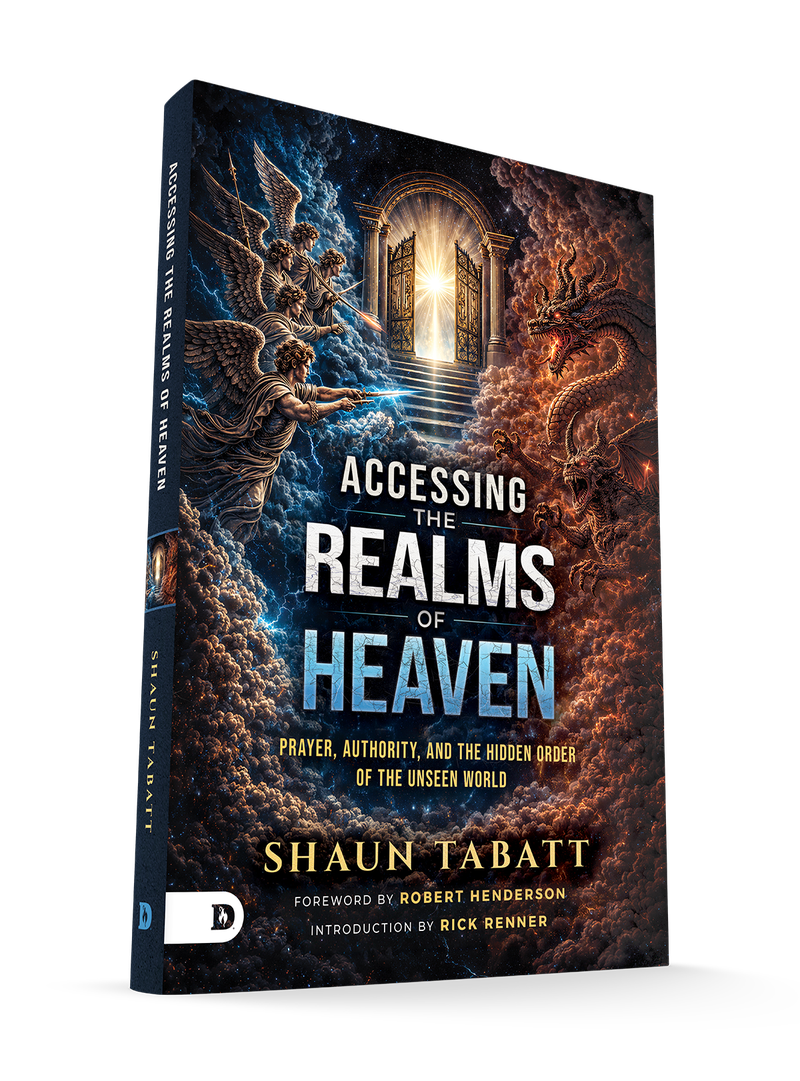
In this powerful and deeply clarifying guide, bestselling author Shaun Tabatt reveals a truth many believers have missed: the unseen world is not chaotic—it is ordered, governed, and anchored in God’s authority.
Through years of research, ministry conversations, and personal experience shaped by grief and unanswered prayer, he shows you that prayer is not about striving upward, but learning to live from the place where God already reigns.
In Accessing the Realms of Heaven, you’ll discover how to:
Understand the biblical structure of the unseen realm
Discern God-led encounters vs. counterfeit experiences
Navigate dreams, visions, and spiritual impressions biblically
Recognize spiritual resistance without fear or obsession
Stand in your identity and authority in Christ
You are not called to strive for access—you are invited to rest in it! It’s time to stop praying from confusion and start living from heaven’s perspective.